The Layers Hidden in a Place Name
Place name meanings can reveal traces of language and landscape. Learn how to check older spellings and local records before drawing a careful conclusion.
What can a place name tell you about the ground beneath it, and what should you check before trusting its apparent meaning? Place name meanings can point towards older languages, local features or people, but the spelling alone rarely settles the story. Start with the name’s recorded forms and the kind of place it identifies.
Choose the feature
Pick a specific name attached to a village, field, hill, neighbourhood or stream. Record its spelling and source, such as an Ordnance Survey map, a council map or a street sign. Then check exactly what the name labels. A word printed beside a stream might name the settlement, not the water.
That distinction can change an interpretation. A name that seems to describe a bend in a river may have belonged to a nearby farm, or may have shifted from one feature to another. Note the location and feature before trying to translate the words.
Check name elements
Some place names combine elements for landscape features, settlements or personal names. But breaking a word into familiar-looking parts can mislead: the same sound may have different origins in different regions, and a modern resemblance may be accidental.
Consult a specialist place-name dictionary or county history. Check which older forms the source uses, what meaning it proposes and whether that meaning is supported by local examples. A glossary of older language forms can clarify a proposed element; a general dictionary may not explain how it was used in a place name.
Compare spellings across records where possible. An early form may preserve a sound hidden by the modern spelling, while later forms can show how pronunciation or writing conventions changed. One spelling variant is a clue to examine, not a verdict.
Compare local names
Nearby names can show whether a proposed element belongs to a wider local pattern. Compare like with like: a stream name and a parish name may have separate histories even if they share a modern sound. Look at what each name refers to and whether their recorded forms resemble one another.
Suppose a place-name reference links an element to wet ground. Check whether other names containing that element occur in similar settings. A cluster near low ground may support the interpretation, but the terrain could have changed, and the element may carry another local meaning.
Read the land
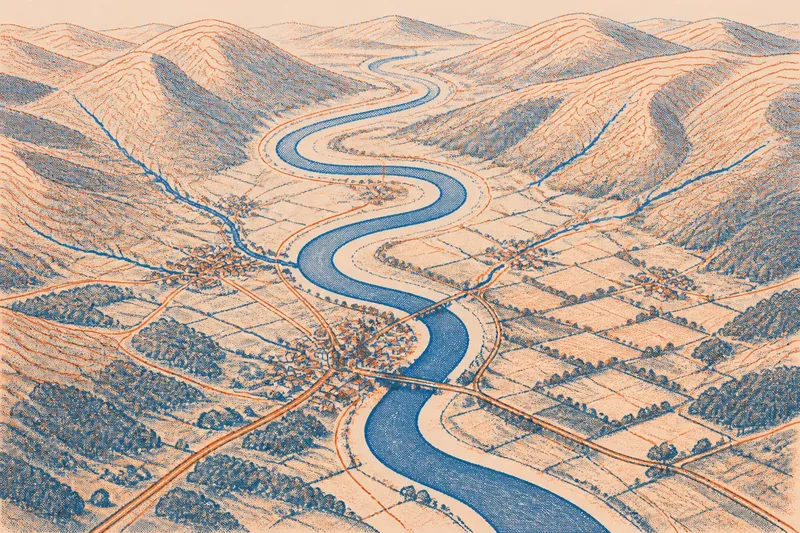
If a name seems to describe a ford, ridge, wood or enclosure, look for that feature on the ground or in mapped records. Contour lines can clarify the shape of a slope; older map editions may show woodland, paths or watercourses that are no longer visible. Local archives and historic environment records can add context, though their coverage varies.
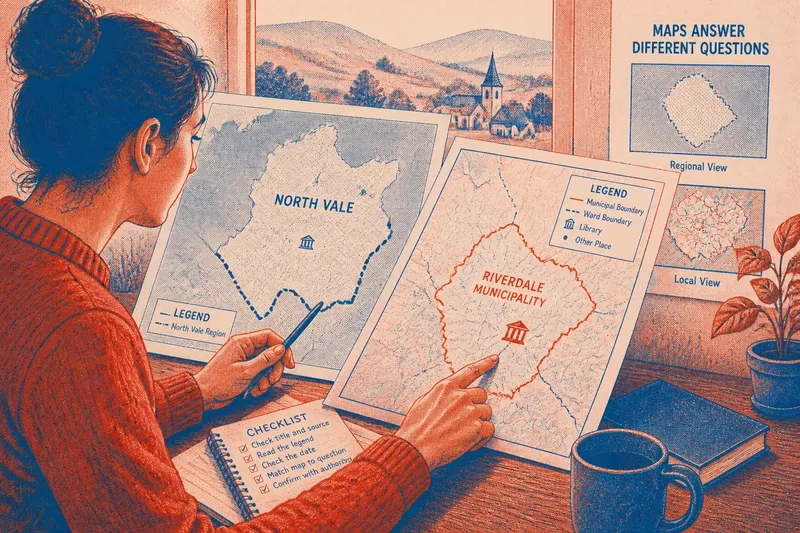
A feature’s absence from a map does not prove it never existed. Maps select details for particular purposes, so a field map, a road map and an estate plan may show different things. Treat a match between name and terrain as supporting context, not as proof of origin.
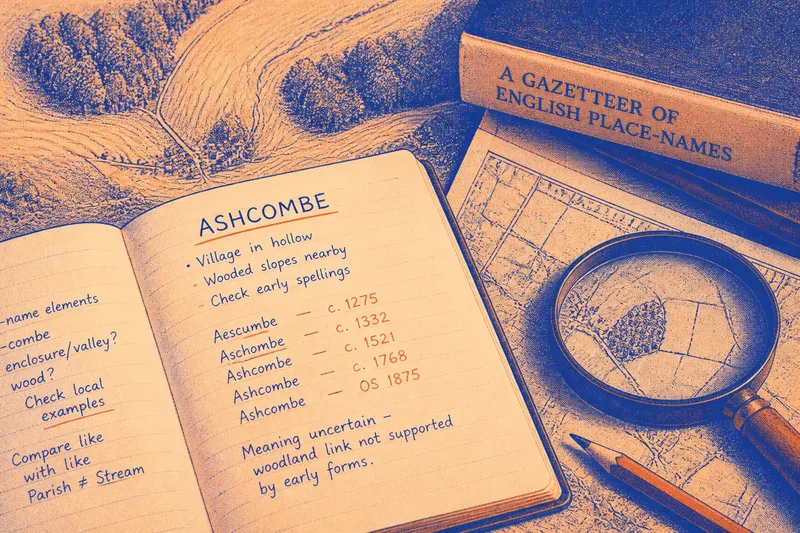
Imagine a researcher finds the invented name “Ashcombe” beside a village hollow. They note that an older map shows woodland nearby, then consult a county place-name reference and find that its earlier spellings do not clearly support the expected woodland element. The sensible result is to keep woodland as a possible association, not to present it as the name’s established meaning.
What do names tell us?
Can a name identify an older language?
It can suggest one when its elements resemble forms used in a language known from the region. Earlier spellings and comparison with local names make that suggestion more persuasive than a resemblance to a modern word alone.
Does a name prove a feature existed?
No. The feature may have disappeared, the meaning may have shifted, or the name may refer to something else. Use the name to guide a search through maps and records, rather than treating it as a physical record by itself.
Why do place-name spellings change?
Names are spoken and written by different people over time, and unfamiliar sounds may be adapted to familiar spelling habits. Compare recorded forms instead of assuming that the current spelling preserves the original pronunciation.
Do similar names share an origin?
They might, but resemblance alone cannot establish a connection. Compare older spellings, local language evidence and the features each name identifies.
Keep claims distinct
Write down the evidence in separate statements: the name’s recorded spelling, the meaning proposed by a source, and any nearby feature shown on a map. This makes it clear which details are documented and which remain an interpretation.
Think of a place name as a label on an old drawer: it can suggest what may once have been inside, but the label is not the contents. If sources disagree, preserve that disagreement in your notes. For a linguistic question, use a specialist place-name reference; for a vanished feature, compare historic maps and local records. That distinction keeps place name meanings useful as clues without asking them to carry more history than the evidence allows.